How to Turn YouTube into a Searchable Knowledge Base
YouTube has 800M+ videos but no way to search inside them. Here's how developers and researchers are turning their video libraries into searchable knowledge bases — and finding answers in seconds instead of rewatching hours of content.
The Skip Team
Skip Team
YouTube's search only finds videos — not what's inside them. A searchable knowledge base extracts transcripts, creates semantic embeddings, and lets you search by meaning across your entire video library. Skip does this automatically: import videos, search by concept, get timestamped answers.
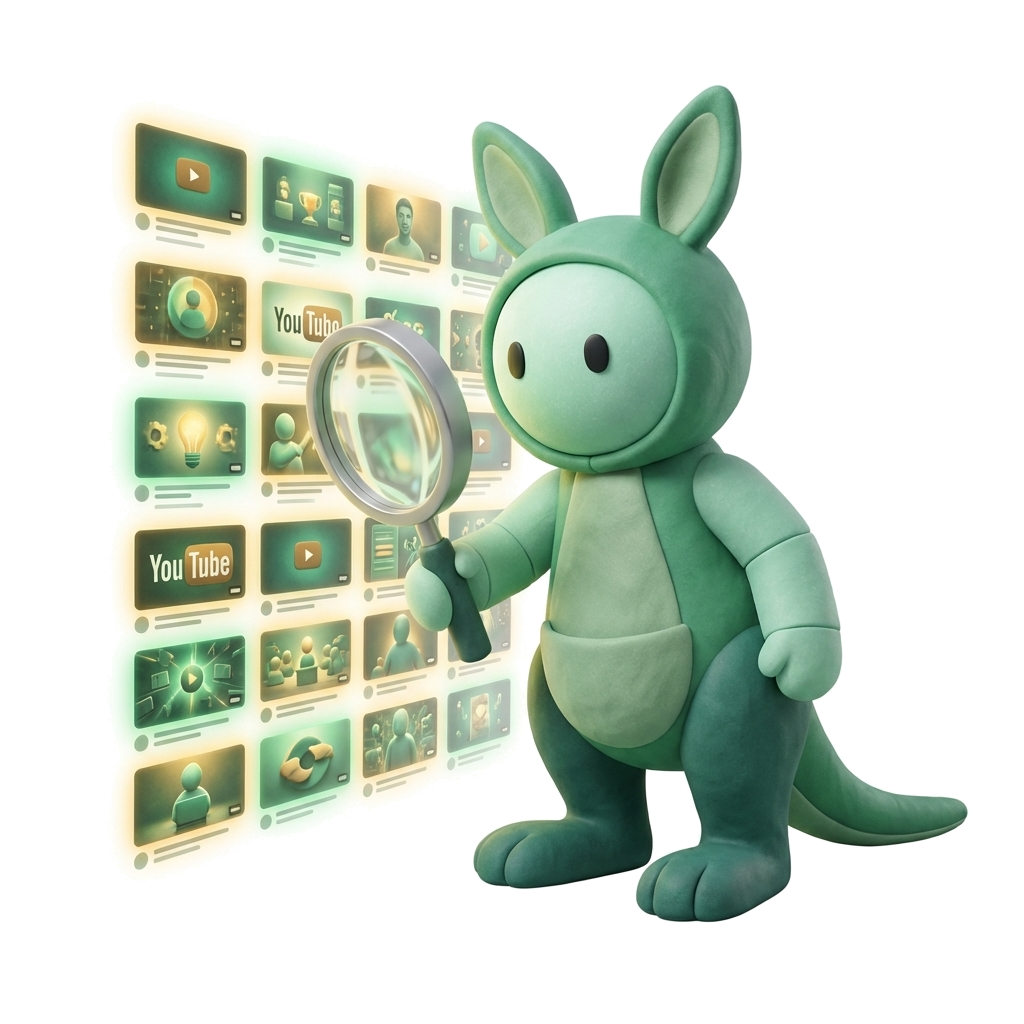
You've watched 47 YouTube tutorials on Kubernetes this year. You remember one of them had a perfect explanation of pod networking — the kind that actually clicked. But which one? Was it the Fireship overview? The KodeKloud deep dive? That random conference talk from KubeCon?
YouTube won't help you find it. Its search finds videos, not what's inside them. Your watch history is a chronological scroll of thumbnails. Playlists don't have search. Bookmarks rot.
This is the gap: YouTube is the world's largest video library with no librarian.
Here's how to fix that — and turn your YouTube watching into a searchable knowledge base you can actually query.
Why YouTube's Built-In Search Fails Knowledge Workers
YouTube search is designed to help you discover new videos, not retrieve information from ones you've already watched. There's a fundamental design difference:
- Discovery search ranks by engagement (views, watch time, CTR). It wants to keep you on the platform.
- Retrieval search ranks by relevance to your specific question. It wants to give you the answer and get out of the way.
YouTube is optimized for the first. Knowledge workers need the second.
Here's what that means in practice:
- Search "kubernetes pod networking" → YouTube shows popular videos about Kubernetes. Not the specific 3-minute segment in a 45-minute talk where pod networking was explained brilliantly.
- Search your watch history → Not possible. YouTube's watch history has no search function at all.
- Search inside a video → You can Ctrl+F the transcript (if one exists), but only keyword matches. Search "how containers communicate" and you'll find nothing, even if the speaker said exactly that using different words.
For anyone who uses YouTube as a learning tool — developers, researchers, students — this is a daily friction.
What "Searchable" Actually Means (It's Not Just Ctrl+F)

When we say "searchable knowledge base," most people imagine keyword search over transcripts. That's table stakes. Here's the real stack:
Level 1: Transcript Search (Keyword Matching)
Extract the transcript, index every word, let users search for exact phrases. This is what YouTube's built-in transcript viewer gives you (sort of). It works when you remember the exact words the speaker used. It fails when you don't — which is most of the time.
Level 2: Semantic Search (Meaning Matching)
Convert transcripts into vector embeddings — mathematical representations of meaning. Now "how containers talk to each other" matches a segment where the speaker said "inter-pod communication via the cluster network." Same concept, completely different words.
This is the breakthrough that makes video knowledge actually useful. You search with your words, and the system understands what you mean. Learn more about how semantic search works.
Level 3: Conversational Search (AI Chat)
Go beyond search queries. Ask your video library a question: "What did that DevOps tutorial say about blue-green deployments vs. canary releases?" The AI reads across multiple videos in your library and synthesizes an answer with timestamp citations.
This is where a knowledge base becomes genuinely more useful than rewatching. You're not just finding a needle in a haystack — you're getting the needle handed to you, polished, with context.
Three Real Scenarios Where This Changes Everything
Let's get specific about when a searchable video knowledge base pays for itself.
Scenario 1: The Developer Learning a New Stack
You're learning Next.js and you've watched 20+ tutorials over two months. You hit a routing issue. Instead of googling and watching another new video, you search your library: "dynamic routes with catch-all segments." Skip surfaces the exact timestamp from a tutorial you watched three weeks ago — right where the instructor demonstrated catch-all routes with a real example. 10 seconds instead of 20 minutes.
Scenario 2: The Researcher Tracking Expert Opinions
You're researching AI safety and you've saved 50 interviews and podcast episodes. Someone makes a claim in a meeting. You search: "alignment tax and compute overhead." The system finds three separate interviews where researchers discussed this exact topic, with direct quotes and timestamps. You just built a citation list in seconds.
Scenario 3: The Student Prepping for Exams
You have 30 lecture recordings from your distributed systems course. Instead of rewatching 45 hours of content before the final, you ask: "Explain the difference between Paxos and Raft consensus algorithms." The AI synthesizes answers from three different lectures, giving you a comprehensive review with links to the original explanations.
How to Build Your Searchable YouTube Knowledge Base
Here's the practical, step-by-step approach. You can do this in under 5 minutes.
Step 1: Curate, Don't Hoard
Don't try to index your entire YouTube watch history. Start with the videos that contain knowledge you'll actually need again:
- Tutorials for tools and frameworks you use daily
- Conference talks that changed how you think about a problem
- Course lectures you might need to reference
- Expert interviews in your domain
Step 2: Import into a Knowledge Base Tool
Skip makes this dead simple. Paste a YouTube URL, and it automatically:
- Extracts the full transcript (works even without captions using AI transcription)
- Generates semantic embeddings for meaning-based search
- Creates key insights so you can scan the content in seconds
- Indexes everything for cross-library search
You can also import entire playlists or channels at once. Got a favorite instructor? Import their whole channel and make every video instantly searchable.
Step 3: Organize with Projects
Group related videos into projects. "React Learning," "System Design," "ML Research." This lets you scope your searches when you want focused results instead of searching everything.
Step 4: Search and Chat
Now the magic works. Search "React server components hydration" and get results ranked by semantic relevance — not by how many views a video got. Or open the AI chat and ask a question that spans multiple videos.
Step 5 (Power Users): Query from Your IDE
Skip has an MCP integration that lets you query your video knowledge base directly from Cursor, Claude, or any MCP-compatible tool. You're debugging a deployment issue and you think "I watched a video about this" — ask your AI coding assistant, and it searches your Skip library without leaving the editor.
Why Not Just Use Google / NotebookLM / Notes Apps?
Fair question. Let's compare:
Google Search: Great for finding new information. Useless for finding something specific from a video you already watched. Google doesn't know your video library exists.
NotebookLM: Solid for loading a few sources and chatting with them. But it's session-based — you upload files, ask questions, and move on. It doesn't maintain a persistent, growing video library with hundreds of videos you can search across anytime. Detailed comparison here.
Notes Apps (Notion, Obsidian): Great if you manually take notes during every video. But that takes 10x longer than watching the video itself. And you'll inevitably miss the one detail you need later.
A searchable knowledge base (Skip): Automated. Persistent. Growing. Import once, search forever. No manual note-taking required. The video content is the knowledge base.
The Compound Effect of Searchable Video Knowledge
Here's what most people miss: the value of a searchable video knowledge base grows exponentially with size.
With 10 videos, it's a nice convenience. With 100 videos, it's a genuine competitive advantage. With 500+ videos, it's like having a research assistant who has watched and remembered everything you've ever studied.
Every video you import makes every future search more useful. That Kubernetes tutorial you saved last month might be the perfect complement to the Docker deep-dive you import next week. The connections compound.
This is why curation matters more than quantity. A focused library of 200 high-quality tutorials in your domain is more valuable than 2,000 random imports. Import with intention, and your knowledge base becomes an extension of your expertise.
Get Started in 60 Seconds
Here's the fastest path to a working searchable YouTube knowledge base:
- Sign up for Skip — free, no credit card
- Import 5 videos you've been meaning to revisit (paste URLs or use the Chrome extension)
- Search for something you remember from one of them — but use your own words, not the speaker's
- See the difference between keyword matching and semantic search
Once you've found one answer in 10 seconds that would have taken 20 minutes of rewatching, you'll understand why searchable beats bookmarkable every time.
Pricing starts free. The Pro plan at $10/mo unlocks 500 videos and 2,000 messages — enough for a serious knowledge base.

Try this yourself
Import a YouTube video into Skip and search it by meaning — not just keywords. Free, no credit card required.
Frequently Asked Questions
How do I turn YouTube videos into a searchable knowledge base?
Use a tool like Skip that extracts transcripts from YouTube videos, creates semantic embeddings for meaning-based search, and lets you search across your entire video library. Import videos by pasting URLs, then search by concept — not just keywords — to find exact timestamps and answers.
Can I search inside YouTube videos by meaning, not just keywords?
Yes. Semantic search tools like Skip convert video transcripts into vector embeddings that understand meaning. So searching 'how containers communicate' will find segments about 'inter-pod networking' even though the words are different. This is called semantic search.
What's the difference between YouTube search and a video knowledge base?
YouTube search finds new videos based on popularity and engagement. A video knowledge base like Skip searches inside videos you've already saved, finds exact timestamps by meaning, and lets you ask questions across your entire library with AI chat.
Is there a free tool to search across YouTube video transcripts?
Skip offers a free tier that lets you import up to 50 videos per month and send 100 chat messages. It extracts transcripts, creates semantic search indexes, and lets you search across all your saved videos by meaning.
How is Skip different from NotebookLM for YouTube videos?
NotebookLM is session-based — you upload sources and chat with them. Skip maintains a persistent, growing video library with hundreds of videos you can search across anytime. It supports bulk imports, channel imports, MCP integration for IDE access, and semantic search across your entire collection.
Related Articles
How to Build a Personal YouTube Knowledge Base in 2026
You've watched hundreds of great YouTube videos this year. Can you find anything from them? Here's a step-by-step guide to building a searchable video knowledge base — so the insights you learn actually stick.
ProductWhat is Semantic Search? How Skip Finds Videos by Meaning
Traditional search matches keywords. Semantic search understands what you mean. Here's how it works and why it matters for finding information in videos.
GuidesHow to Search Inside YouTube Videos (Not Just Titles)
YouTube search finds videos. But what if you need to find a specific moment inside a video — a technique, a code snippet, an explanation you watched last week? Here's how to actually search inside video content.
ProductHow to Query Your YouTube Library from Cursor and Claude with MCP
Your AI coding assistant doesn't know what you've learned from YouTube. Skip's MCP server changes that — here's how to connect your video knowledge base to Cursor and Claude Code.
Ready to try Skip?
Turn your YouTube videos into a searchable knowledge base. Start free, no credit card required.